- Ancient history
- Roman centuries to the early Middle Ages
- Morocco
- Algeria
- Tunisia
Roman and Late Antique North Africa: Five Ways to Read a Changing World
A city, two authors, a royal inscription and an excavation show why North African history cannot be reduced to successive labels on a map.
Editorial source check; ancient self-description is kept distinct from modern ethnic attribution. No external specialist review is claimed. · Source/review record dated 2026-10-05. What our review labels mean.
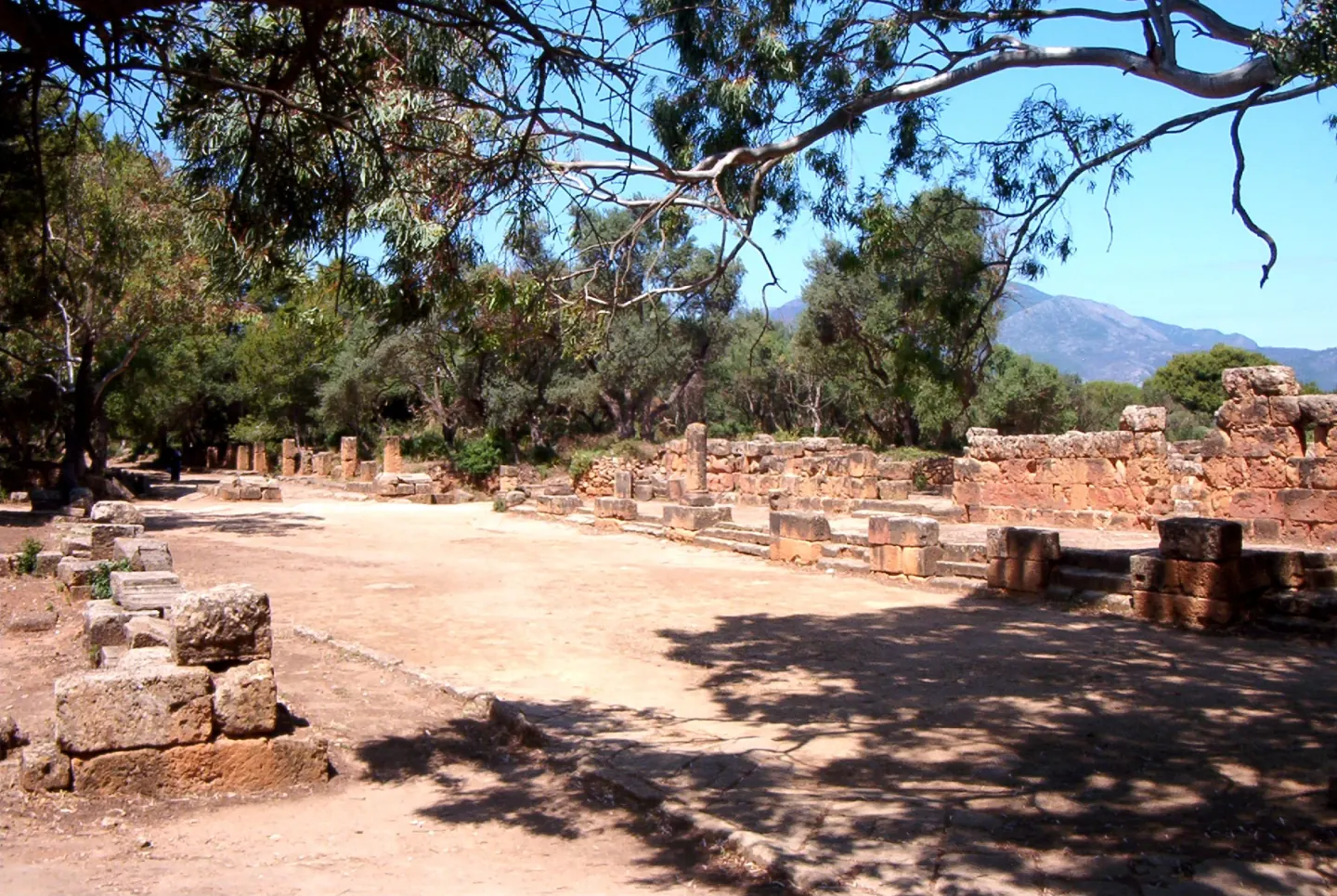
A city: Volubilis before and after Rome
Volubilis, in present-day Morocco, has a history longer than its best-known Roman monuments. UNESCO’s property record identifies a Mauretanian past, Roman urban development and a later connection with Idris I. The surviving buildings and inscriptions give historians different kinds of evidence for these successive settings.1
A columned street is visible and memorable. Less monumental occupations can be harder to recognise. The question “what happened after Rome?” therefore cannot be answered just by looking at the most impressive standing remains. A site’s later inhabitants may have repaired, subdivided or reused earlier structures.
An author describing his own origins
In chapter 24 of his Apologia, Apuleius describes his homeland as lying on the boundary of Numidia and Gaetulia and calls himself half Numidian and half Gaetulian. He then argues that birthplace does not determine a person’s moral worth. The passage supplies an ancient self-description, but it is also a rhetorical defence addressed to an audience.2
Those features belong together. We should preserve his terminology rather than substitute a modern census category. A North African author could use Latin literary forms and assert regional origins in the same work. “Roman” and a local affiliation were not automatically mutually exclusive.
Augustine and the experience of language
Augustine’s Confessions, Book I, chapters 13–14, recalls his attraction to Latin literature and dislike of learning Greek. Written later as a Christian reflection on his youth, the account reveals both education and the meaning he retrospectively gave it. It is valuable evidence of a particular North African life, not a survey of everyone’s home language.3
A modern reader may commemorate Augustine within several overlapping histories. Establishing what languages he used, where he studied and what he wrote is a different exercise from certifying a modern ethnic identity. Birthplace alone cannot do the latter.
A king after imperial authority receded
The Latin inscription from Altava dated to 508, catalogued as CIL VIII 9835, names Masuna as ruler of Moorish and Roman peoples. Paul-Albert Février studies it beside the inscription associated with Masties. These texts are rare evidence of how rulers presented authority in a changing political landscape.4
The paired labels are the important clue. The political world after Roman imperial government cannot be explained as the simple removal of everything Roman. At the same time, one royal dedication cannot establish the exact borders of a kingdom or the ancestry of all its subjects.
An excavation that bridges the period labels
Elizabeth Fentress, Corisande Fenwick and Hassan Limane report excavations at early Islamic Walila, the later name of Volubilis. Their work investigates substantial eighth-century urban evidence at a site often presented primarily as Roman. Archaeology makes it possible to ask about households and changing settlement organisation as well as kings and conquest.5
Taken together, these examples show a region where governments, religious affiliations, languages and everyday practices changed at different speeds. Continue with Islamisation and Arabisation, keeping those processes distinct, or explore how inscriptions are read.
Sources and further reading
Numbered markers in the text refer to the works below. We cite published scholarship, primary texts and institutional documents; we do not cite page numbers we have not verified, and we do not treat encyclopaedias or aggregators as final authorities on substantive claims.
- UNESCO World Heritage Centre, “Archaeological Site of Volubilis,” property 836, description and statement of outstanding universal value. Official record.
- Apuleius, Apologia 24, Latin text with commentary in Dickinson College Commentaries. Text and commentary.
- Augustine, Confessions I.13–14, J. G. Pilkington translation, Nicene and Post-Nicene Fathers, first series, vol. 1 (1887). Primary text. Translation language is nineteenth century.
- Paul-Albert Février, “Masuna et Masties,” Antiquités africaines 24 (1988), pp. 133–147; inscription CIL VIII 9835. Article. Indexed article passages consulted.
- Elizabeth Fentress, Corisande Fenwick and Hassan Limane, “Urban life in early Islamic Morocco: new light from the excavations at Walīla (Roman Volubilis)” (2022). Institutional record; report full text.
Spotted an error, a better source or a spelling that a community prefers? Send us a correction. Substantive corrections are logged on the article once made.