Place and cultural landscape
Siwa Oasis
The oasis in Egypt’s Western Desert that is the easternmost Amazigh-speaking community, site of the ancient oracle of Amun and of the salt-built town of Shali.
Names, spellings and related terms: Siwa · Isiwan · ancient Ammonium
Source check: 2026-10-05. Source-linked additions and identified corrections checked; independent specialist review remains pending.
- Type
- Oasis and cultural region
- Modern territory
- Matruh governorate, Egypt, roughly 50 km from the Libyan border
- Landscape
- A depression below sea level with salt lakes, springs, and dense date and olive groves
- Language
- Siwi, the easternmost Amazigh language
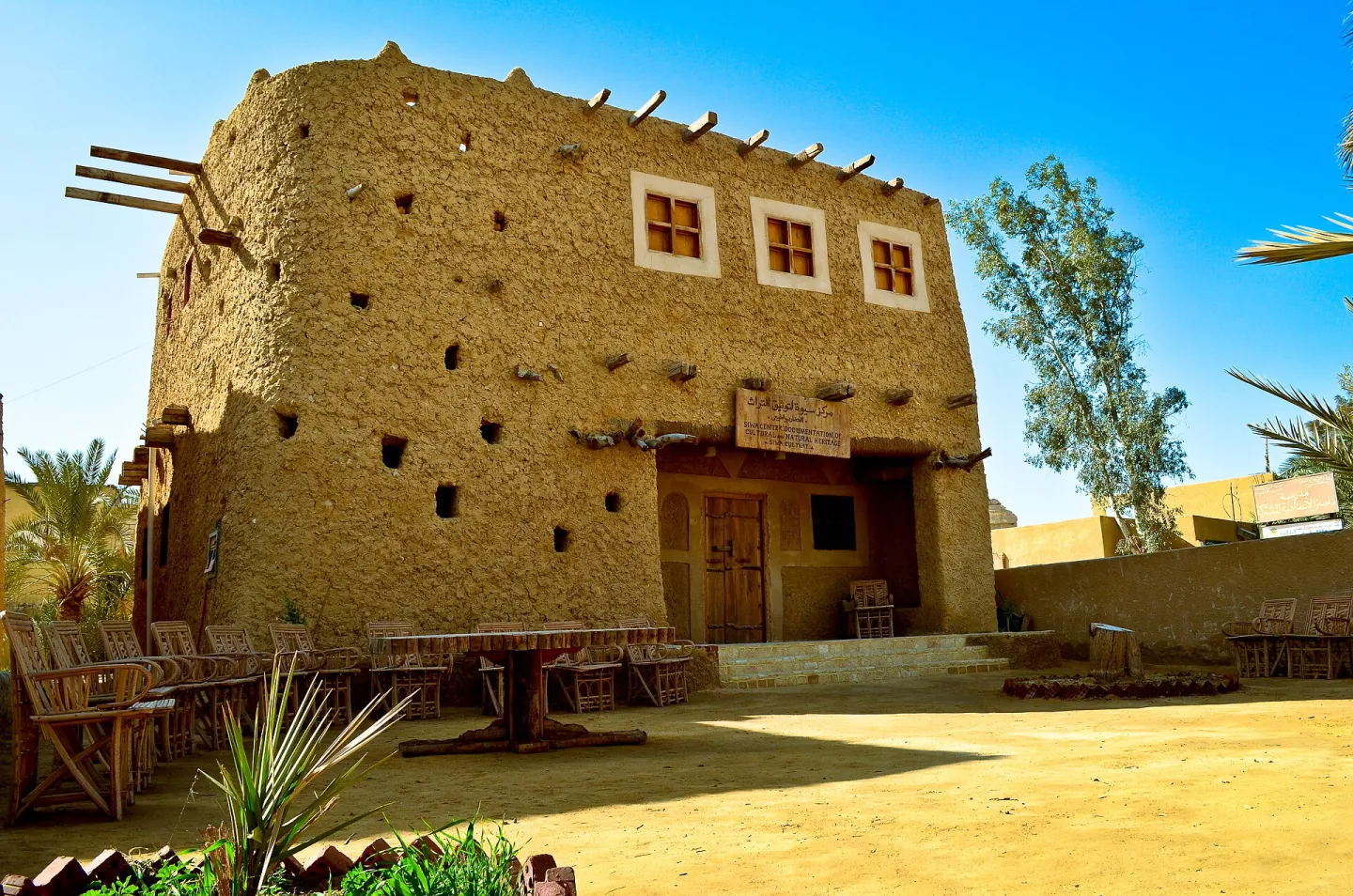
The oasis
Siwa lies far from the Nile valley, but geographical separation is not the same as cultural isolation. Both archaeological objects and the extensive Arabic contact visible in Siwi provide evidence of connections beyond the oasis. Language survival cannot be explained by distance alone. 123
Amzruy
The oasis was the site of the oracle of Amun, one of the most celebrated oracles of the ancient Mediterranean, consulted by Alexander the Great in 331 BCE. The temple and the necropolis of Gebel al-Mawta remain significant archaeological sites.
The medieval and early modern settlement centred on Shali, a fortified town built of kershef — blocks of salt-rich mud — whose ruins still dominate the oasis; much of it dissolved after exceptional rains in the 1920s. Siwa was only intermittently subject to Egyptian state authority before the nineteenth century. Road connections, tourism and modern media have transformed it within living memory.
Cultural landscape
Siwan silver jewellery and embroidered bridal dress are highly distinctive and widely collected. Date and olive cultivation remain economically central. Popular travel writing about Siwan customs is frequently sensationalised and poorly sourced; specialist ethnographic and linguistic work, in particular on the Siwi language, is a far better guide.
Evidence earlier than Alexander’s visit
A small marble ram provides a different starting point from the familiar story of Alexander. Vaelske re-examines a statuette brought from Siwa to Berlin by Gerhard Rohlfs in 1869, proposing a date in the late sixth century BCE. He interprets it as evidence relevant to Greek religious engagement with the sanctuary before the better-documented classical period. This is an argument from an object, not an eyewitness account of a named pilgrim. 2
The study makes two distinctions useful for reading oasis history: the date an artefact was made is not the date it entered a museum, and an interpretation of its religious use is not the same as a securely documented personal biography. The ancient sanctuary’s Mediterranean connections and modern Siwi’s language contacts belong to different periods, but both caution against representing Siwa as a sealed cultural survival. 23
Sources and further reading
- Lameen Souag, Berber and Arabic in Siwa (Egypt) (Cologne: Rüdiger Köppe, 2013).
- Veit Vaelske, “Ein Widder für Ammon. Ein früher Beleg für griechische Votivpraxis in der libyschen Oase Siwa”, Archäologischer Anzeiger 2017/2, pp. 31–47 (online 2019). DOI: 10.34780/a1lh-sd6h.
- Lameen Souag, Grammatical Contact in the Sahara: Arabic, Berber, and Songhay in Tabelbala and Siwa, PhD thesis, SOAS, University of London (2010). DOI: 10.25501/SOAS.00013430.
Community names, spellings and emphases vary. If you can point us to a better source or a preferred spelling, tell us — corrections are logged once made.