Place and cultural landscape
The Nafusa Mountains
The escarpment of north-western Libya, an early centre of Ibadi learning and the heartland of Libya’s Amazigh communities.
Names, spellings and related terms: Jebel Nafusa · Adrar n Infusen · Western Mountains
Source check: 2026-10-05. Source-linked additions and identified corrections checked; independent specialist review remains pending.
- Type
- Mountain escarpment and cultural region
- Modern territory
- North-western Libya, south-west of Tripoli
- Key settlements
- Yefren, Jadu, Nalut, Kabaw; related communities at Zuwara on the coast and at Ghadames
- Language and religion
- Nafusi; substantially Ibadi Muslim in the mountains
The region
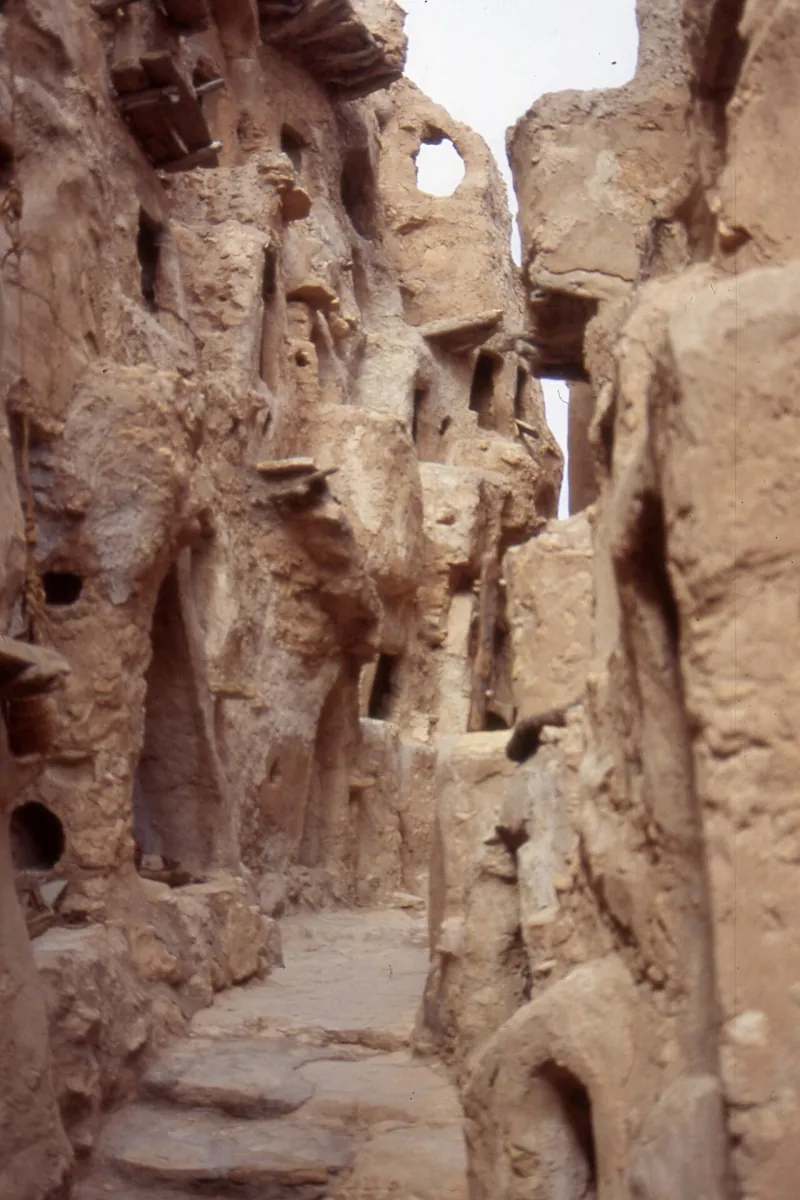
The Nafusa is an escarpment running east to west above the Jefara plain, with hilltop villages, cave and underground dwellings, terraced olive cultivation and fortified collective granaries known as qasr. The granaries at Nalut and Kabaw, honeycombs of small vaulted storage cells stacked several storeys high, are among the most striking vernacular structures in North Africa.
ⴰⵎⵣⵔⵓⵢ
The Nafusa was a major centre of Ibadi scholarship in the early Islamic centuries, producing a substantial literature and maintaining links with Ibadi communities on Djerba, in the Mzab and in Oman. Under Ottoman and then Italian rule the region retained a distinct character, and it was involved in the resistance to Italian colonisation from 1911.
Human Rights Watch’s 2011 report recorded state restrictions on Amazigh-language schooling, media and official names under Gaddafi. Minority Rights Group’s account of 2013 subsequently documented new minority-language media and cultural festivals after his fall. These dated reports establish a major change in public expression; they are not a statement of Libya’s current legal or security situation. 23
Cultural landscape
Olive oil production, communal granaries and Ibadi religious institutions define the region. Since 2011 the public celebration of Yennayer and the open use of Tifinagh signage have become visible markers of a cultural life that was previously suppressed.
Small mosques and a wider scholarly network
Prevost’s architectural research places the Nafusa within an Ibadi network also connecting Djerba and the Mzab. Her comparison identifies shared features such as outdoor prayer areas and multiple prayer niches, alongside pronounced regional differences. Nafusa and Djerba include small, sometimes partly underground mosques; their forms should not be inferred from the tall, austere minarets commonly associated with the Mzab. 1
Architecture thus helps show both connection and local adaptation. An Ibadi affiliation is not a guarantee of identical buildings, and a building’s present appearance is not enough to establish its original date or every stage of its use. This profile concerns the mountain region. The coastal community of Zuwara and the oasis community of Ghadames have separate language histories and should not be absorbed into one Nafusi entry.
Sources and further reading
- Virginie Prevost, “Les mosquées ibadites du Maghreb”, Revue des mondes musulmans et de la Méditerranée 125 (2009), pp. 217–232.
- Human Rights Watch, World Report 2011: Libya, historical reporting on restrictions on Amazigh-language education, media and names.
- Minority Rights Group, State of the World’s Minorities and Indigenous Peoples 2014, Libya section, reporting developments during 2013.
Community names, spellings and emphases vary. If you can point us to a better source or a preferred spelling, tell us — corrections are logged once made.