Place and cultural landscape
Volubilis / Walila
The archaeology of Volubilis reaches beyond its Roman monuments into an early medieval town and the beginnings of Idrisid rule.
Names, spellings and related terms: Volubilis · Walila · Walīla · Walili
Source check: 2026-10-04. Sources checked for the additions on this page; independent specialist review is not claimed.
Site location: 34.07389°, -5.55694°. An orientation point for this site, not a cultural boundary. Explore the atlas.
More than a Roman ruin
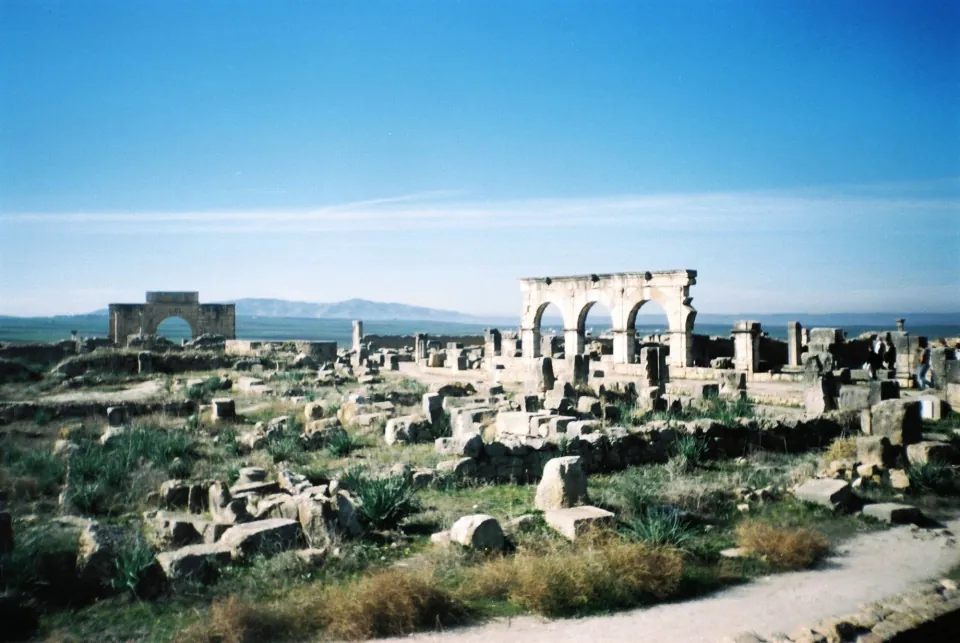
Volubilis stood in the landscape at the foot of Jebel Zerhoun. Its surviving monuments are especially associated with Roman urban life, but its archaeology records periods before and after Roman government. The ancient kingdom of Mauretania should not be confused with the modern state of Mauritania. 1
UNESCO’s record describes changes in urban layout and a rich body of inscriptions, mosaics and sculpture. Each kind of evidence answers a different question: decoration reveals choices made for a particular building, while inscriptions can identify an office, dedication or relationship. 1
Walila and an early Islamic town
Research by Elizabeth Fentress, Corisande Fenwick and Hassan Limane examines the site under its medieval name, Walila. Their account of the 2018–2022 excavations places the town within the formation of an early Islamic state and the career of Idris I. It also identifies a possible earlier caliphal garrison, retaining that interpretation as a probability rather than a certainty. 2
The significance is methodological as well as political. Excavating early medieval occupation makes it possible to ask how people used streets, buildings and domestic space after the better-known Roman phase. The story does not end when a Roman institution disappears from the written record.
A small object and everyday life
A recent study examines a game board from the medieval bathhouse. The authors use the building’s archaeological context to constrain its date and interpret the design as a possible form of the game known as tab or sig. The proposed identification should remain attached to that evidence and its limits. 3
Such an object supplies a different scale of history from a dynasty’s foundation. It opens questions about sociability and shared space without allowing us to reconstruct the exact players, rules or outcome of an individual game.
Reading the site across periods
The atlas places Volubilis in an ancient snapshot. This profile extends the chronology so that the visible Roman remains do not obscure Walila. Follow Juba II’s biography for the royal context and the excavation publications for the early medieval city.
Conservation and interpretation also shape what a visitor sees. Keep an excavation plan, a restored monument and an artist’s reconstruction distinct. Their visual authority can look similar even though the evidence behind them differs.
Sources and further reading
- UNESCO World Heritage Centre, “Archaeological Site of Volubilis”, World Heritage List no. 836, inscription 1997; Statement of Outstanding Universal Value and coordinate. Site record.
- Elizabeth Fentress, Corisande Fenwick and Hassan Limane, “Urban life in early Islamic Morocco: new light from the excavations at Walīla (Roman Volubilis)”, Archaeology International 25.1 (2022), pp. 111–131, DOI 10.14324/111.444.ai.2022.08. UCL repository.
- Tim Penn, Corisande Fenwick and Hassan Limane, “Gaming in the Maghreb al-Aqsa: new evidence from Idrisid Walīla (Volubilis)”, Libyan Studies (2026), DOI 10.1017/lis.2025.10033. Author manuscript at UCL.
Community names, spellings and emphases vary. If you can point us to a better source or a preferred spelling, tell us — corrections are logged once made.