Language reference
Nafusi
Nafusi documentation, the differences between Yefren and western mountain varieties, and the contribution of community recordings.
Names, spellings and related terms: Nefusi · Nefoussi · Jebel Nafusa Berber
Source check: 2026-10-05. Introductory claims checked against the cited working paper and publisher records; no independent specialist or community review is claimed.
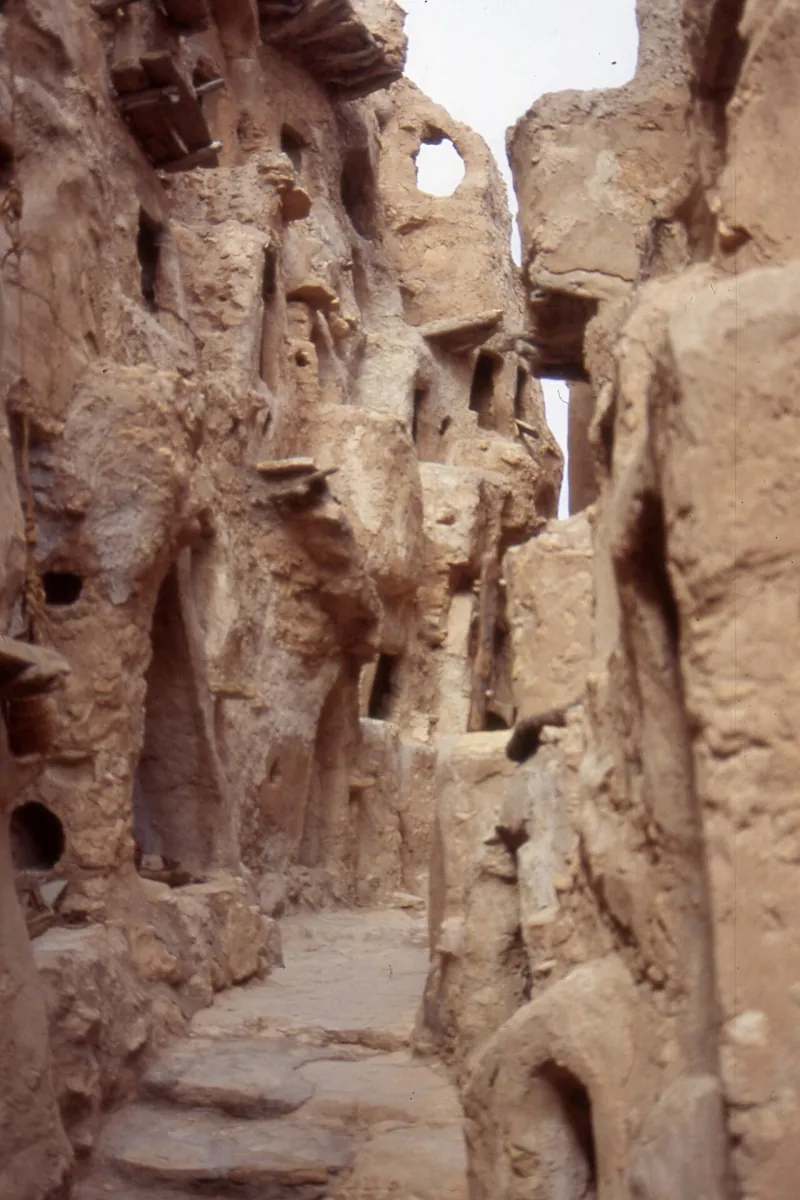
A mountain region with internal variation
Nafusi names Amazigh varieties of the Nafusa Mountains. Mariacarmela Flaviano’s 2024 working paper compares Yefren in the east with Jadu and Jemmari in the west. Its starting point is a gap in documentation: the older reference grammar primarily represents western material, while Yefren has received less comprehensive description.1
This matters whenever “Nafusi” appears on a map or in a lesson. A broad label can be useful for orientation while leaving substantial local differences unresolved. The Nafusi community profile follows the regional history; the language page asks which locality and body of speech a particular grammatical claim describes.
What recent comparison investigates
Flaviano compares noun forms in different grammatical settings, sentences without a verb, and verbal negation. Her Yefren material includes seven transcribed oral narratives recorded in 2000–2001 and later shared through community work. The paper explicitly presents preliminary findings, not a complete grammar of all mountain varieties.1
The source history is part of the linguistic evidence. A recording, its later transcription and its scholarly analysis are different stages. Where information about individual narrators or recording places was not retained, that limits the questions the collection can answer. It does not remove the value of the narratives, but it prevents treating them as a representative survey of every village.1
An identifiable learning resource
Anna Maria Di Tolla and Mohamed Shinnib’s Grammatica di berbero nefusi was published by Hoepli in 2020. The publisher describes twelve teaching units, exercises, translated narrative and descriptive texts, and an Italian–Nafusi and Nafusi–Italian vocabulary. It reworks earlier materials, including Francesco Beguinot’s grammar, for Italian-speaking learners.2
A structured course offers something a list of translated words cannot: a sequence through spelling and grammatical patterns, followed by practice in connected language. Its intended audience and documentary basis should remain visible. The fact that a book teaches Nafusi does not establish that every example is equally usual in Yefren, Nalut or Jadu.
Connections beyond the mountains
Ghadames has its own grammatical description, based on a distinct documentary tradition. It should therefore be approached through its separate community profile, as should coastal Zuwara. Libya is a political setting containing several Amazigh language histories, not a linguistic unit in itself.3
For comparisons, attach the locality, source and date to the form being discussed. This page offers no unverified audio, present-day speaker count or imported phrase list. Further learning should combine documented materials with speakers able to explain the usage of their own locality, including differences between a written exercise and everyday conversation.
Iɣbula d tɣuri-nniḍen
- Mariacarmela Flaviano, “Preliminary remarks on linguistic variation within Nafusi Amazigh based on data from Yefren (Libya)”, Maydan 4 (2024), pp. 111–127, especially introduction and methodology. Working paper.
- Anna Maria Di Tolla and Mohamed Shinnib, Grammatica di berbero nefusi (Milan: Hoepli, 2020). Publisher’s description, authors and contents. The full textbook was not consulted.
- Maarten Kossmann, A Grammatical Sketch of Ghadames Berber (Libya) (Cologne: Rüdiger Köppe, 2013). Publisher’s documentation summary.
Community names, spellings and emphases vary. If you can point us to a better source or a preferred spelling, tell us — corrections are logged once made.