Regional community profile
Nafusi communities of Libya
Amazigh communities of the Nafusa Mountains and western Libya, long marginalised under state policy and central to Amazigh mobilisation after 2011.
Names, spellings and related terms: Infusen · Nefusa · Jebel Nafusa communities · Nafusi speakers
Source check: 2026-10-05. Source-linked additions and identified corrections checked; independent specialist and community review remains pending.
- Preferred names
- Infusen; Nafusi in English. The mountains are the Jebel Nafusa or Nafusa Mountains.
- Where
- The Nafusa Mountains south-west of Tripoli, including Yefren, Jadu, Nalut and Kabaw. Zuwara and Ghadames have separate profiles.
- Tutlayt
- Nafusi varieties of the mountain region; do not use Nafusi as a blanket name for every Amazigh language in Libya.
- Religion
- Substantially Ibadi Muslim in the mountains, with Sunni populations elsewhere
- Diaspora
- Communities in Tripoli and in Europe, particularly following the conflicts after 2011
Location and landscape
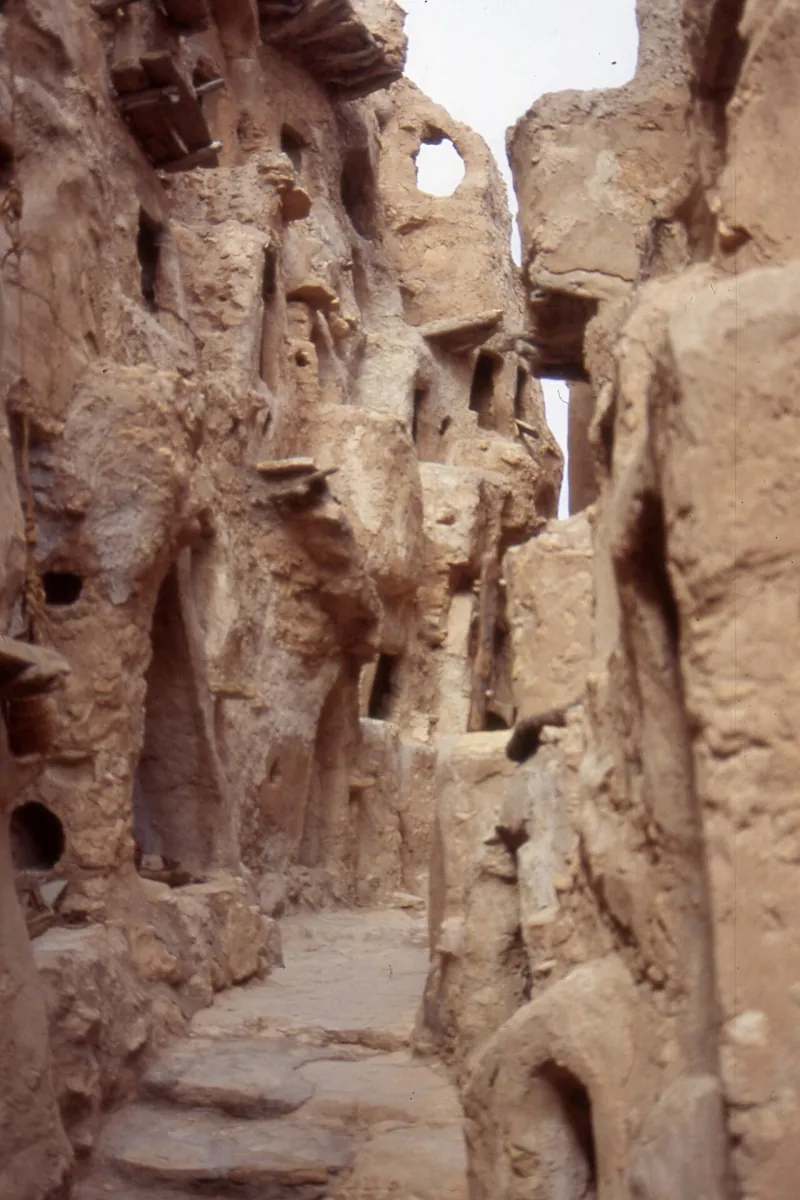
The Nafusa is an escarpment running east to west across north-western Libya, rising above the Jefara plain. Its settlements combine hilltop villages, underground and cave dwellings, terraced olive cultivation and fortified collective granaries known as qasr, several of which survive in impressive condition at Nalut and Kabaw.
Language and religion
Nafusi is associated with the mountain settlements. Ghadames and coastal Zuwara have their own documented varieties and social histories. Shared Ibadi connections do not make all these communities linguistically identical; the regional religious network also extends to Djerba and the Mzab. 12
Amezruy
The Nafusa was an important centre of Ibadi learning in the early Islamic centuries, producing a substantial scholarly literature. Under Ottoman and then Italian rule the region retained a distinct character; Italian colonial rule from 1911 met sustained resistance across Libya, with the Nafusa involved in the fighting of the 1910s and 1920s.
In its 2011 report, Human Rights Watch described prohibitions affecting Amazigh-language teaching and media, as well as official names. Minority Rights Group’s report on 2013 records minority-language media and cultural festivals in the period after Gaddafi. This dated contrast documents an opening in public cultural expression; it does not establish the present legal position, security conditions or a unified political programme for every Nafusi town. 34
Living culture
Olive cultivation, communal storage buildings and religious institutions belong to the region’s material and social history. The appearance of new public cultural events after 2011 should be understood alongside household transmission and older scholarly networks, not as the beginning of Amazigh culture in Libya. 14
Terminology and caveats
Reporting on Libya frequently treats Amazigh communities as a single political bloc. In practice the Nafusa towns, Zuwara and Ghadames have distinct histories, dialects and interests, and their positions within Libya’s post-2011 conflicts have not been uniform.
Religious networks without cultural uniformity
Prevost’s research follows Ibadi scholarship and mosque forms across the Maghreb. The Nafusa was not simply a remote endpoint: it belonged to networks through which learning and religious authority moved. Her comparison with Djerba and the Mzab shows why religious affiliation is useful historical context without functioning as a complete ethnic or architectural label. 1
Readers can follow this network through the Nafusa place profile, then compare Ghadames and Zuwara. The point of separate entries is not to deny connections, but to make it possible to name precisely which settlement, text, language variety or institution a claim concerns.
Iɣbula d tɣuri-nniḍen
- Virginie Prevost, “Les mosquées ibadites du Maghreb”, Revue des mondes musulmans et de la Méditerranée 125 (2009), pp. 217–232.
- Maarten Kossmann, A Grammatical Sketch of Ghadames Berber (Libya), Berber Studies 40 (Cologne: Rüdiger Köppe, 2013). Ghadames is treated separately, not as a mountain locality.
- Human Rights Watch, World Report 2011: Libya, historical report on Amazigh language and naming restrictions.
- Minority Rights Group, State of the World’s Minorities and Indigenous Peoples 2014, Libya section, reporting on 2013.
Community names, spellings and emphases vary. If you can point us to a better source or a preferred spelling, tell us — corrections are logged once made.