Language reference
Siwi
Siwi’s grammar preserves evidence of a long history of language contact in Egypt’s western desert.
Names, spellings and related terms: Siwan · Siwa Berber
Source check: 2026-10-05. Sources checked for this introductory reference; specialist language review pending.
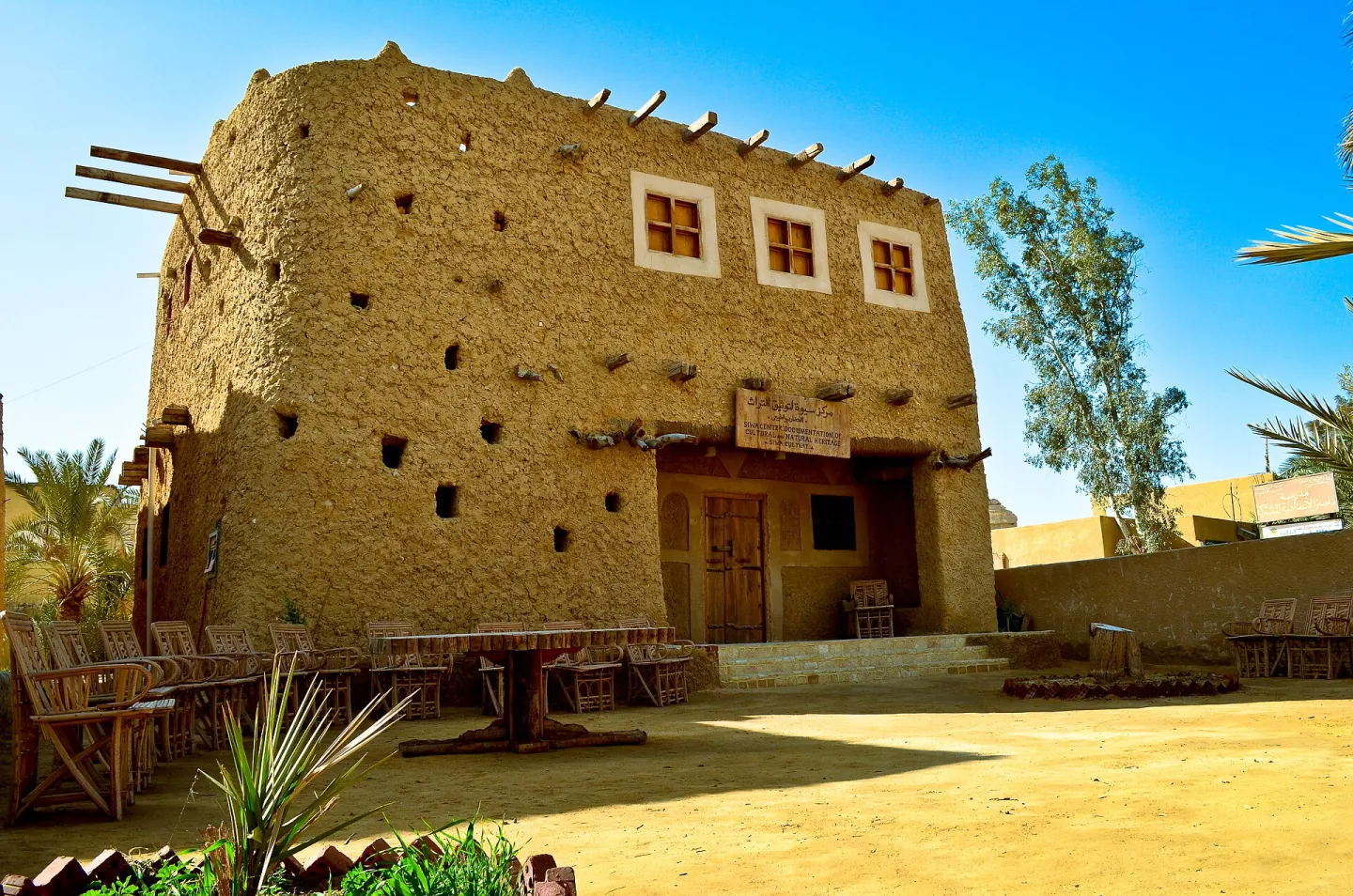
A language at an oasis crossroads
Siwi is associated with Siwa Oasis and its Siwi community. Its location at the eastern end of Amazigh-speaking North Africa makes it valuable for studying both the Amazigh family and the movement of languages through the Sahara.
Lameen Souag’s research approaches Arabic influence as a layered history. The material does not reduce to a list of recent borrowed words: it reflects contact with different Arabic varieties at different times. That distinction helps explain why modern Egyptian Arabic alone cannot account for everything found in Siwi. 1
Contact changes grammar as well as vocabulary
Souag documents borrowing that affects word formation and sentence structure, including numeral-and-measure expressions and constructions used to focus information. His study sets these changes alongside inherited Amazigh structures. Language contact is therefore part of the language’s history, not evidence that the language is deficient or inauthentic. 1
His earlier article uses the Arabic layer in Siwi to investigate Arabic dialect history. Certain features point toward older sedentary Arabic connections rather than deriving straightforwardly from nearby modern Bedouin speech or the Nile Valley. These are linguistic arguments from particular forms, not a complete census of historic migrations. 2
Texts, speakers and transcription
A grammatical description is strongest when its examples can be related to real speech. Souag’s 2013 volume includes a small collection of texts of several kinds, including religious narratives and poetry. A text’s genre matters: a poem and ordinary conversation do not necessarily use language in the same way. 1
A research transcription should not be silently merged with an unrelated Amazigh writing standard. Christfried Naumann’s phonetic study proposes an orthographic representation after analysing the sound system. A scholarly proposal is evidence of a particular notation, not proof of universal community agreement. 3
Reading further
Start with the contact study for the historical argument and with the phonetic study for its notation and sound analysis. Check a source’s transcription key before interpreting unfamiliar letters.
This page does not provide a beginner phrasebook. Its purpose is to show why Siwi deserves its own account and to connect the reader with identifiable documentation. Translating an English phrase into a different Amazigh variety and relabelling it Siwi would not produce reliable learning material.
Sources and further reading
- Lameen Souag, Berber and Arabic in Siwa (Egypt): A Study in Linguistic Contact, Berber Studies 37 (Cologne: Rüdiger Köppe, 2013). Publisher’s account of the fieldwork and contents.
- Lameen Souag, “Siwa and its significance for Arabic dialectology”, Zeitschrift für Arabische Linguistik 51 (2009), pp. 51–75. SOAS repository record and abstract.
- Christfried Naumann, Acoustically Based Phonemics of Siwi (Berber), Berber Studies 36 (Cologne: Rüdiger Köppe, 2012), xxii + 436 pp., especially chapter 8 on orthographic representation. Publisher’s description.
Community names, spellings and emphases vary. If you can point us to a better source or a preferred spelling, tell us — corrections are logged once made.